Sand from Newton’s Seashore

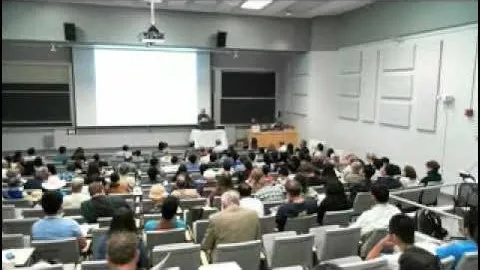 Sand from Newton’s Seashore: John Paulin introduces Charles Townes
John Paulin gave this talk on July 20, 2013, at the Fourth Annual Townes and Tagore Seminar on the Global Water Crisis, UC Berkeley, to introduce the chief guest, Charles H. Townes. Paulin has a doctorate in interdisciplinary humanities from UC Berkeley, where he studied Greek tragedy and Greek and German philosophy.
I have been asked to introduce Charles Townes: the man who gave the world the laser, the 1964 Nobel laureate in physics, a recipient of India’s Tagore Award, a scholar who writes about the convergence of science and religion, and a 2005 Templeton laureate. That is saying a lot.
I admired Dr. Presti’s talk. I have heard him before, and I find him very inspiring. Some of my ground has already been covered, and I was at a loss for where to start, so I decided on the direct approach: how to be like Charles Townes.
1. Solve Real Problems for Wider Social Benefit
Radar was developed during World War II, in the fight against genocidal fascist governments that were trying to destroy democracy around the world. Charles was devoted to public service then, and he still is. He is a problem solver: he makes science happen, and that science saves lives.
This is not Charles’s first water crisis. His first, as readers of his biography will know, came during the war. The microwaves he and his colleagues were using had a wavelength of 1.25 centimeters, which is very good for microwave ovens but bad for radar over the ocean. That drove them to shorter wavelengths, and ultimately to the maser. Calling it a water crisis is, I confess, a joke.
2. Up the Ante
Make science happen again, but in ways that all the authorities claim are impossible. You know the story. Niels Bohr told him it was impossible. Even John von Neumann told him so, as did Rabi and many others. He went out and did it.
3. Ignore Authorities
Charles is not a rebel by any means, but he is a man of incredible conscience. If he thinks he has the answer and you tell him he is wrong, he will not listen; he will persevere.
He was not always like this. In graduate school, as I read in his biography the other night, he determined the spin of carbon-13 to be one-half, but his professor at Caltech insisted that the result was wrong. In Charles’s words: “I didn’t quite know how to contradict my professor, so I let the results come out.” Apparently he learned fast, for he believes that the episode taught him to be “still more stubborn.”
I think of this stubbornness as conviction and dedication. These qualities go a long way toward explaining the character and values of the man, and how, through him, they contributed to the laser, an incredible invention that is changing our world.
4. Persistence
When you know, or believe, that you are onto something, you persist. Persistence is a close cousin of stubbornness.
5. Success
Success proves that you were right all along. Many people stop here to bask in it, but not Charles. He does not wait for the dust to settle; he gets out and lets everyone else do the dirty work.
6. Look for New Challenges
Charles wants to invent something new. After he had finished with the microwave laser, the maser, he did get the first patent on a laser. But as I recall from his biography, which I read last year, he thought there was too much competition once everyone knew how to do it, so he went on to something else. He became a pioneer in the discovery of complex molecules in outer space, and of course all the authorities in that field said it was not possible.
Plenty of people will be there to clean up the rich, wonderful mess you leave behind. Consider all the masers and lasers: people are still inventing new masers, and that is not old news.
7. Repeat
Go back to step three and start the process over with a different set of authorities. Charles, again, is no rebel. I sure would be.
8. Generosity
Generosity, too, is science. It is Charles the man, and it is what brings forth, builds, and develops knowledge in this world: the sharing of ideas, the building of community, and respectful dialogue with others. All of these are Charles Townes. In an interview I found online, he puts it this way:
If you’re too much of a loner, then you lose what many other people have discovered and known. You want to know what they know and to build on that. And they should know what you know and be able to build on that. Also, just trying out ideas and talking about things: some chance comment may allow you to recognize something that the person making the comment hasn’t recognized.
Charles is a very introspective man. Read his book and you find him absorbed in the internal nature of matter: things happen in his mind, he has hunches, and he works on them. Yet those hunches are often triggered by things that other people know and he does not. The process is an interaction, and interaction is itself a field of discovery. Ideas come about in conversation: in seeing somebody else’s work, thinking about it, and looking at it from another perspective.
For Charles, then, science is about people working together, but it is also fun. It is a game and, I think, a celebration of the universe and of his connection to it. He keeps saying that he does not retire because it is too much fun. In my view, his game is much the same as Newton’s. Asked to describe himself, Newton said that he felt like a boy playing on the seashore, picking up smooth pebbles and prettier shells, all the while unaware of the great ocean of truth around him. With due respect to Dr. Presti, and although I am not a neuroscientist, I believe that the great ocean of truth is much bigger than anything we are going to find.
9. Search for Ever Greater Unity
Think of everything that is done with the laser, and of how much we know about the cosmos that we would not know without it. It is as if Charles had taken the sand from Newton’s seashore and put it in a box, and now every modern science plays in it. In some sense, Charles’s game is modern science. And we are all in it too, because our Blu-ray players, our laser printers, and much else all use lasers. Everybody is indebted to Charles.
Part of what drives Charles is the wish to examine nature and find its unity. He has done a great deal with lasers, and now he has gone off to find molecules in space. He has been interested in that since graduate school, so it was about time to do something different.
Physics is, after all, an attempt to find greater and more beautiful unities. Our theories grow more and more complicated, but overall they give us a sense of some great unity that we can describe in ever better terms. That, I think, is what lies behind M-theory: the power of mathematics to construct beautiful models. And the models, when we can test them, often work.
Science creates unity. It builds great, magnificent cosmological temples: the structure of creation, as Charles would probably put it. What I learned from David Presti, though, is that at the same time people like him are taking the brain apart, laying it out in little pieces on the table, and asking, “How the hell does this work?”
So as science progresses in one direction, everything that people like Dr. Townes contribute to the unity of what we know is undone by Dr. Presti. That is just why I love both men. They are my favorite professors at Cal, although I never studied with either of them. I wish I had, but then, I was only in the humanities.
Mathematics is an incredible power, and all we know is that it works. Among the works Dr. Presti read was one I recommend to all of you: “The Unreasonable Effectiveness of Mathematics in the Natural Sciences,” a remarkable essay by Eugene Wigner, who received the Nobel Prize before Charles. Wigner asks why mathematics works, and more particularly why beautiful mathematics works. He thinks that mathematicians are narcissists who sit around making beautiful theories to impress one another and do not give a damn about the universe. Yet this is the kind of mathematics that makes science work. Why it works, we have absolutely no idea; Wigner says that we are simply lucky, and that we do not deserve it, either. This is not the anthropic principle; it is the misanthropic principle. The essay is one of my favorite works of epistemology, a subject I have studied.
The brain, though, works the other way. To return to Dr. Presti, the Dalai Lama, and Vivekananda, to whom Dr. Townes wished us to dedicate this conference: India has another approach to the mind. I am not capable of speaking about it, because I am just Western metaphysics, and we think we know everything.
Modern science, as I understand it, is about unity. But Charles is not just a scientist, and there are other ways to think about the unity of things. Where does unity begin with Charles, with anything, with our species? With generosity, I think. We were generous beings, social beings, before we were human beings: our primate forebears were both. You have heard Charles’s own words: he wants to open dialogues with people. Search Google for Charles and sharing, and you will see people say that he is incredibly open with his ideas.
The Templeton Laureate
Charles is also a theologian who talks about the convergence of science and religion, and an admirer of Tagore the poet, visionary, and scholar. A Christian, he is, like his wife, Frances, passionately committed to social justice, and equally passionate that the benefits of progress be shared with the developing world, especially with the least fortunate: the least of his brethren, as the Bible puts it. He is an incredible man.
Charles told me to read the works of Vivekananda. I went online, downloaded nine volumes of them, and could not make sense of them. Fortunately, he also told me to read Romain Rolland on the life of Vivekananda. Rolland won the Nobel Prize in Literature, so that makes perfect sense, although the book is, of course, only an introduction. Charles recommends that we all read it. I have it in English translation; it cost me eight bucks, and I had it sent overnight express, so it arrived only yesterday and I cannot claim to be much of an authority.
What I gather, to the extent that I understand Vivekananda, is that he believed America had gone astray: that it confuses progress with the aggrandizement that comes with it, which is to say greed, indifference to the needs of others, and a relentless focus on self-improvement to the exclusion of a social conscience. This is spiritual suicide. It is not what Charles Townes wants to do with technology. His question is a different one: can we help other people, not just ourselves? Vivekananda was a smart man, so he had a lot of good things to say about America, too, but he called it as he saw it.
I am not a theologian, but Vivekananda’s assertions seem to me eminently compatible with the golden rule and a sound basis for a theory of social justice, which Charles and Mrs. Townes believe in and practice.
Charles wants science to work with religion. This is not a matter for theologians writing papers in academies and schools. Science works with religion when it gets out into the field, starts talking to ministers and preachers, to churches, mosques, and temples, and asks, “What can we do for you?” It has to work with policy, too. It is a big, complicated undertaking, but it works in Charles’s spirit of generosity.
You will hear more about Tagore from Rash, so I should stop here. It is my great pleasure to introduce Charles Townes, the 1964 Nobel laureate in literature. Literature? He did recommend a Nobel laureate in literature, so he might well have won one himself had he chosen that career. He is a very good writer, and his explanation of the laser really rocks, so don’t read Wikipedia. I am just another guy with a PhD. But here is Charles.
Adapted from the talk and edited for reading.