International Scientific Conference in Dhaka, 2025

- When
- Friday to Sunday, December 19–21, 2025
- Where
- Dhaka, Bangladesh (venue to be announced)
- Theme
- Science, technology, and the global water crisis
- Keynote
- Thomas Südhof, Nobel laureate, Stanford University
- Organizers
- The IIBHB and the proposed Bajitpur District Committee, Kishoreganj, with partners in Bangladesh, India, and the United States
- Call for speakers
- Send a short résumé to info@iibhb.org or call +1 (510) 618-9398
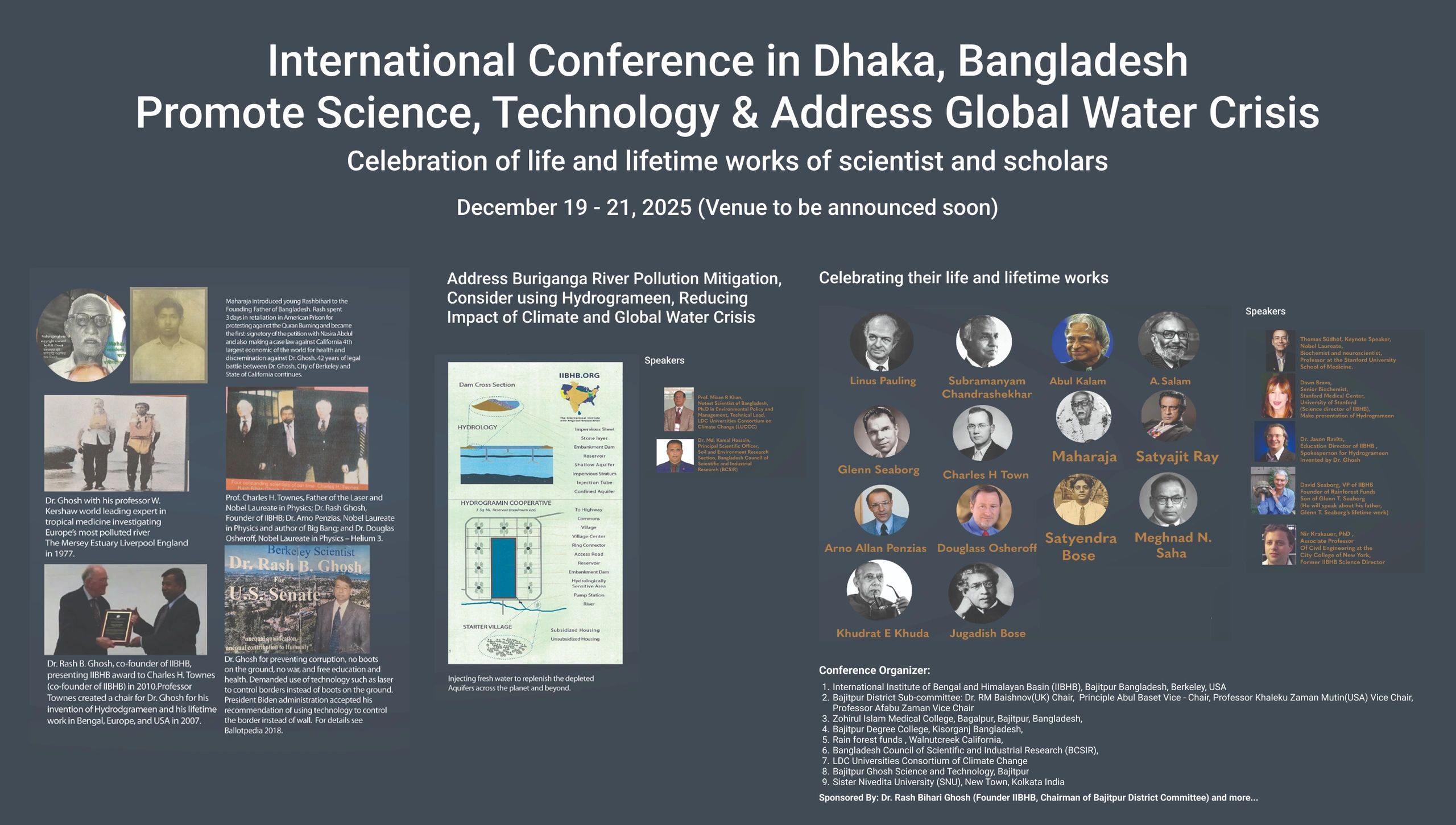
From December 19 to 21, 2025, the International Institute of Bengal and Himalayan Basins will hold an international scientific conference in Dhaka, Bangladesh. For three days, scientists, scholars, and environmentalists will meet to promote science and technology and to look for answers to the global water crisis.
We organize the conference with the proposed Bajitpur District Committee of Kishoreganj, the Bangladesh Council of Scientific and Industrial Research, and colleges, universities, and foundations in Bangladesh, India, and the United States. We hope to have the President of Bangladesh open the conference.
Honoring great minds
At its heart, the conference is a celebration of the life and work of great scientists and scholars. Their ideas still guide us as we work on the global water crisis and global warming, and against systemic racism and the economic divide between East and West.
Nobel laureates
- Linus Pauling, Nobel Prizes in Chemistry (1954) and Peace (1962)
- Glenn T. Seaborg, Nobel Prize in Chemistry 1951
- Charles H. Townes, Nobel Prize in Physics 1964
- Arno Allan Penzias, Nobel Prize in Physics 1978
- Abdus Salam, Nobel Prize in Physics 1979
- Subrahmanyan Chandrasekhar, Nobel Prize in Physics 1983
- Douglas Osheroff, Nobel Prize in Physics 1996
Pioneers of science and culture in South Asia
- Sir Jagadish Chandra Bose, physicist and plant biologist, a pioneer of radio science
- Satyendra Nath Bose, physicist, whose statistics gave the boson its name
- Meghnad Saha, astrophysicist, known for the Saha ionization equation
- Muhammad Qudrat-i-Khuda, chemist and educator
- A. P. J. Abdul Kalam, aerospace scientist and President of India
- Satyajit Ray, filmmaker and Academy Award honoree
- Maharaja T. N. Chakraborty, freedom fighter
Saving the Buriganga
The third day turns to a problem close to home. The Buriganga, the river of Dhaka, is one of the most polluted rivers in the world. For more than 75 years its water has harmed the health of the nation, and a solution is long overdue. Scientists and environmentalists will discuss how to clean up the river, how HydroGrameen can help, and how to reduce the impact of climate change and the water crisis.
Dhaka and its river, the Buriganga, have been the victims of great environmental injustice.
— Dr. Rash Bihari Ghosh, Charles Townes Professor and founder of the IIBHB
The day continues the work of our seminar on the Buriganga at the National Press Club in Dhaka in November 2023 (see Climate, Water, and Justice in Bangladesh).
Speakers
- Thomas Südhof (keynote), neuroscientist and professor at the Stanford University School of Medicine, Nobel Prize in Physiology or Medicine 2013
- David Seaborg, evolutionary biologist, founder of the World Rainforest Fund, and a former vice president of the IIBHB, on the life and work of his father, Glenn T. Seaborg
- Dawn Bravo, PhD, senior biochemist at Stanford Medical Center and a director of the IIBHB, who will present HydroGrameen
- Jason Ravitz, PhD, director of education at the IIBHB and a spokesperson for HydroGrameen
- Nir Krakauer, PhD, associate professor of civil engineering at the City College of New York and a former science director of the IIBHB
- Prof. Mizan R. Khan, scholar of environmental policy and management, and technical lead of the LDC Universities’ Consortium on Climate Change
- Dr. Md. Kamal Hossain, principal scientific officer in the Soil and Environment Research Section of the Bangladesh Council of Scientific and Industrial Research
Organizers
The IIBHB organizes the conference with:
- the Bajitpur District Sub-committee: Dr. R. M. Baishnov (UK), chair, and Principal Abul Baset, Professor Khaleku Zaman Mutin (USA), and Professor Afabu Zaman, vice chairs
- Jahurul Islam Medical College, Bhagalpur, Bajitpur
- Bajitpur Degree College, Kishoreganj
- Bajitpur Ghosh Science and Technology, Bajitpur
- the Bangladesh Council of Scientific and Industrial Research (BCSIR)
- the LDC Universities’ Consortium on Climate Change (LUCCC)
- Sister Nivedita University, New Town, Kolkata
- the World Rainforest Fund, Walnut Creek, California
The conference is sponsored by Dr. Rash Bihari Ghosh, founder and chairman of the IIBHB and chairman of the proposed Bajitpur District Committee.
Call for speakers
We welcome faculty, researchers, and experts from universities and research institutions, and all who carry on the work of the scholars we honor. We especially invite scientists and environmentalists with ideas for the Buriganga. Your talk will help inspire a new generation of scientists in emerging economies, where science and technology are needed most.
To be considered as a speaker, send a short résumé to info@iibhb.org or call +1 (510) 618-9398. Suggestions and comments are welcome too.
Together, we hope to bring East and West closer, and to work toward a more peaceful and sustainable world.
The invitation is also on the website of the proposed Bajitpur District.